They focus on access when the real differentiator is usage.
In its latest Economic Index, Anthropic mapped one million conversations against 20,000 work tasks across 800 occupations.
One finding stands out.
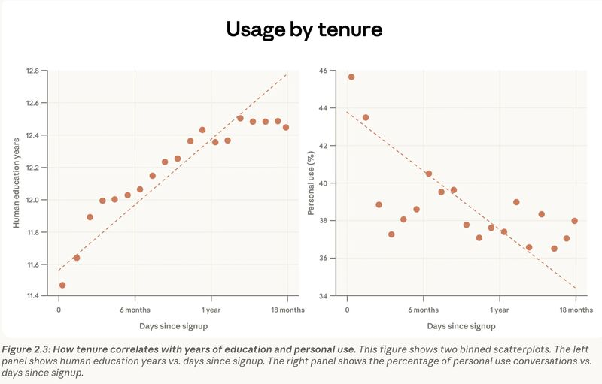
Experienced AI users, those with six months or more of regular use, achieve 4 to 10% higher success rates than newer users on the same tasks. Each additional year of usage correlates with roughly one more year of schooling in the task complexity that users ask AI to perform.
Something important to notice: users are doing different work, not just the same work faster. Instead, they focus on work that extracts more value from the same technology everyone else has access to.
The difference lies in how they engage. Newer users tend to give direct, one-off commands: ‘write this for me’. Experienced users, however, iterate. They question outputs, refine prompts, and steer the reasoning process. Anthropic refers to this as ‘task iteration’, which is directly linked to better results.
For companies with 50 to 500 employees, this creates an internal divide. Early adopters manage more complex tasks and deliver higher-quality outputs.
AI training delivered as a one-off workshop is useful but misses the point. The capability is developed through repeated use, not merely instruction.
That is why workflows matter. Teams need to use AI as part of how work gets done, not as a separate tool.
The organisations that embed AI into everyday work, where teams practise, iterate, and learn in context, will pull ahead of those treating it as a rollout.